


July 15, 2026
Beta Flies Manufactured Organs in First eIPP Mission
- Posted in
- Health and Life Sciences
- News + Press

By Hanneke Weitering • Originally posted HERE
Beta Technologies completed the first operational flights under the FAA’s eVTOL Integration Pilot Program (eIPP) today, carrying manufactured organ products in development by United Therapeutics across a corridor of four airports in Virginia and Maryland.
This inaugural eIPP campaign involved the company’s Alia CX300 electric airplane, a conventional takeoff and landing (CTOL) version of the Alia 250 eVTOL that Beta is also working with the FAA to certify. Beta expects to have the CX300 model certified by year-end, followed by the eVTOL version about 12 months later.
The flights covered approximately 275 nm, with stops at Virginia Tech Montgomery Executive Airport (KBCB) in Blacksburg, Virginia; Charlottesville-Albemarle Airport (KCHO) in Charlottesville, Virginia; Frederick Municipal Airport (KFDK) in Frederick, Maryland; and Martin State Airport (KMTN) in Baltimore County, Maryland.
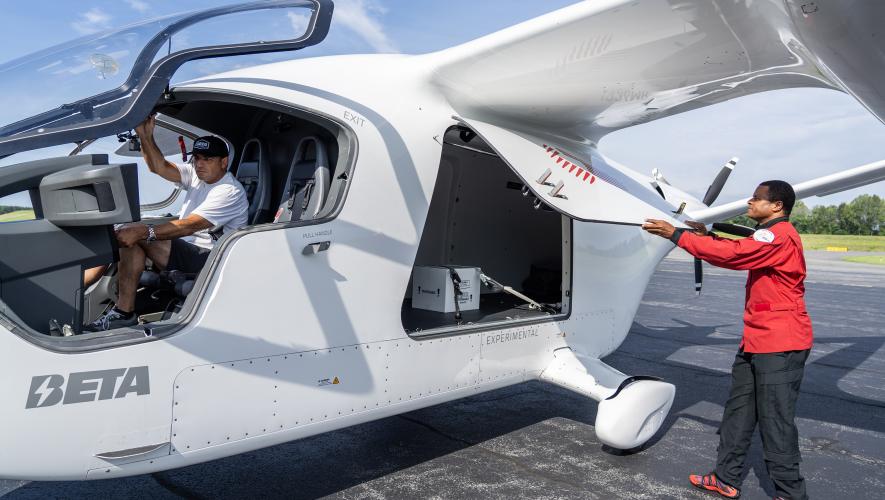
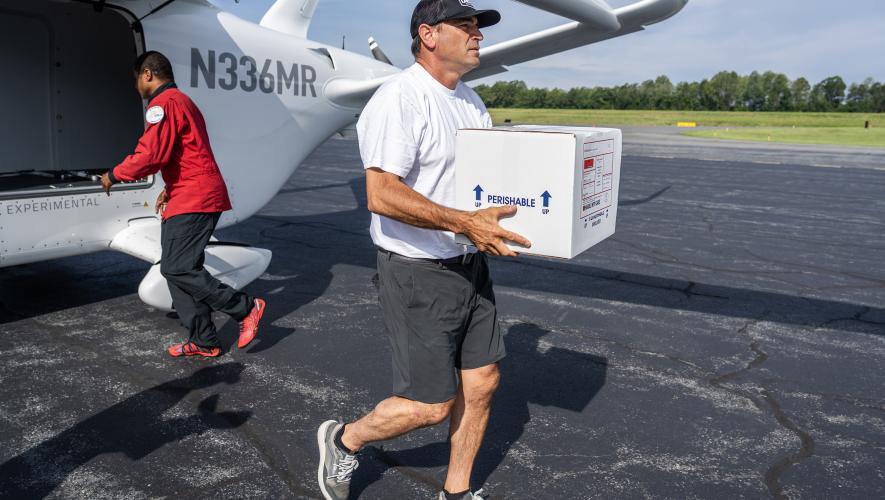
Flight-tracking data indicates two Alia CX300s shared the mission in relay: N336MR flew the Blacksburg-to-Charlottesville leg before handing off to N916LF—the first production example of the type—which then continued to Frederick and Martin State.
Beta conducted the missions with the Multistate Collaborative eIPP National Integration Complex, working alongside the Pennsylvania Department of Transportation, the Virginia Department of Aviation, and the Maryland Aviation Administration.
The U.S. Department of Transportation and the FAA established the eIPP to test how advanced air mobility (AAM) aircraft can operate safely in routine commercial service within the national airspace system, using early operational demonstrations to shape future certification policy and operating rules. Beta was selected earlier this year for seven of the FAA’s eight eIPP launch programs, the largest footprint of any electric aircraft developer in the program.
“Our public-private partnerships are essential to safely unlocking the full potential of these revolutionary aircraft,” said FAA deputy administrator Chris Rocheleau. “Each eIPP project will showcase the broad public benefits of this technology—from moving people and cargo to supporting lifesaving emergency response—and the data we gather will help shape policies for safe, scalable operations nationwide.”
United Therapeutics, Beta’s launch customer, aims to mass-produce transplantable organs and has ordered both versions of the Alia aircraft to deliver those products once they reach the market. The company maintains that AAM aircraft will make large-scale organ logistics cheaper, more reliable, and more sustainable than today’s methods. United Therapeutics and its Unither Bioelectronics delivery-technology subsidiary are also exploring hydrogen-powered variants of Robinson helicopters.
Beta founder and CEO Kyle Clark framed the eIPP flights as the fulfillment of the partnership’s founding contract. “United Therapeutics contracted Beta to build an electric aircraft capable of delivering lifesaving cargo, and today we delivered on that agreement,” he said, adding that the Alia fleet has logged more than 160,000 nm and that the company has built charging infrastructure at 123 sites in the U.S. and Canada.

“Our mission to manufacture an unlimited supply of transplantable hearts, kidneys, lungs, and livers requires thousands of organ delivery flights per day,” said United Therapeutics CEO Martine Rothblatt. “Our FDA-approved clinical trials for the heart, kidney, and bridge-liver, and this month’s FDA approval of our lung device, show how quickly this mission is being achieved. Today’s flight demonstrates how public-private collaboration can accelerate air transport innovation and thus help enable millions of lives to be saved over the coming decades.”
Led by PennDOT, the Multistate Collaborative includes 18 states, four aircraft manufacturers, and three operators, according to PennDOT bureau of aviation director Anthony McCloskey. The partners cast the Pennsylvania-Virginia-Maryland campaign as the first in a series of operations—expected to reach at least 26 states—that will expand to additional mission profiles across healthcare, cargo, and defense.